Water Use

Data center water use depends on the cooling system.

Some data centers use very little water. Others use more because they rely on evaporative cooling. The important question is not whether a building is a data center - it is how that facility rejects heat.

The basic idea

Servers turn electricity into heat. Cooling systems remove that heat from the building. Different systems do this in different ways, and that is where water usage changes.

Servers create heat
->
Cooling system collects heat
->
Heat is rejected outside

Two major cooling categories

Lower Water Use

Closed-loop, air-cooled, and dry cooling

Closed-loop systems reuse the same water or coolant over and over. Air-cooled and dry-cooler systems reject heat to outdoor air instead of relying on evaporation during normal operation.

These designs usually have much lower ongoing water consumption, though they may use more electricity during hot weather or require larger outdoor cooling equipment.

Read the deep dive ->
Higher Water Use Potential

Open-loop / evaporative cooling

Evaporative systems use water to help reject heat. These systems can be efficient electrically, but they may consume more water depending on climate and operating conditions.

Compare both systems ->

Cooling choices change the water story

Two data centers can be the same size and still have very different water profiles. The cooling system, local climate, water source, and operating schedule matter more than the label on the building.
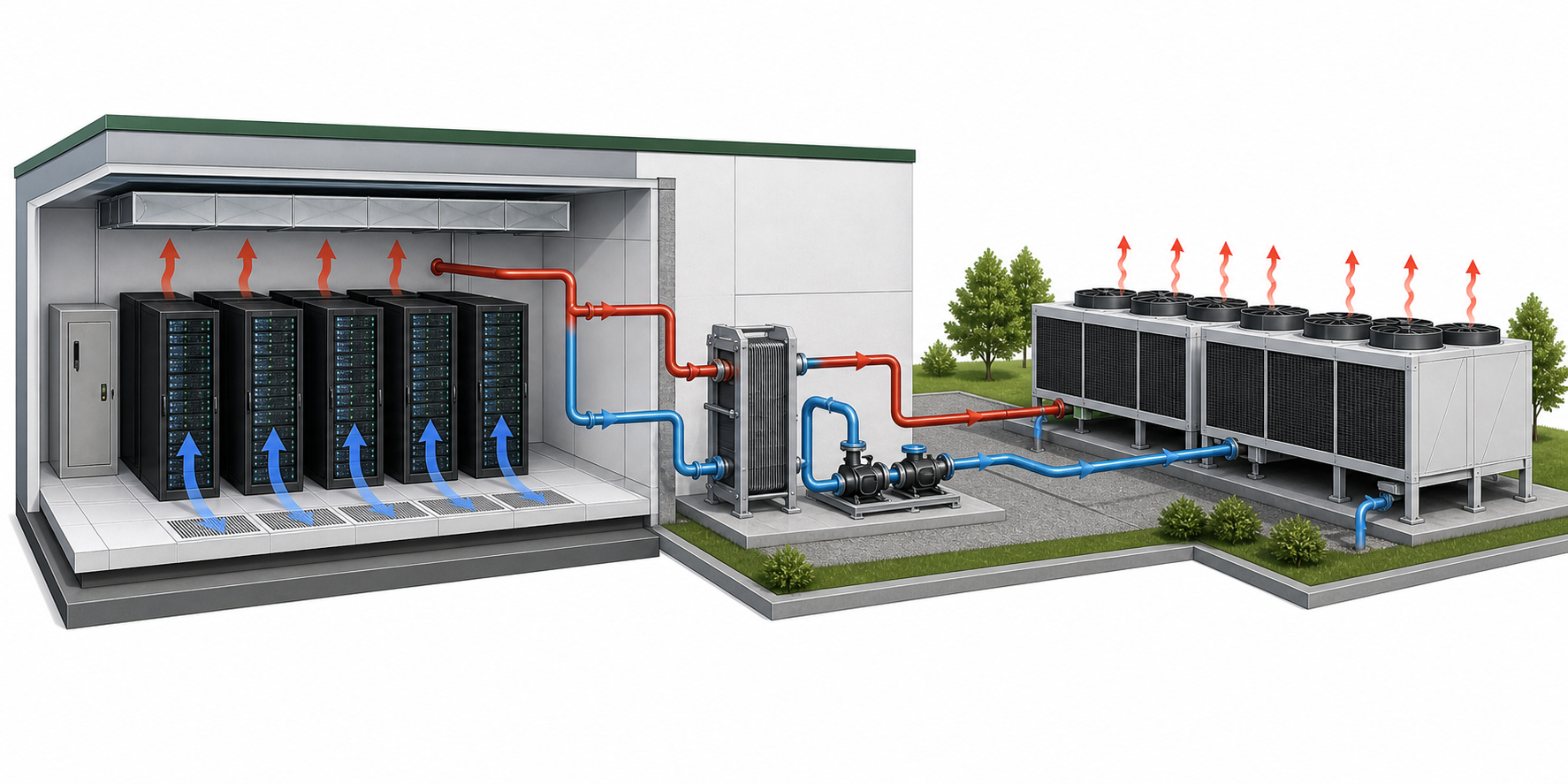
Educational illustration of closed-loop or dry data center cooling Lower Water Use

Closed-loop / dry cooling

Heat moves through a sealed loop and is rejected through dry coolers, air-cooled chillers, or other equipment that does not normally consume water through evaporation.
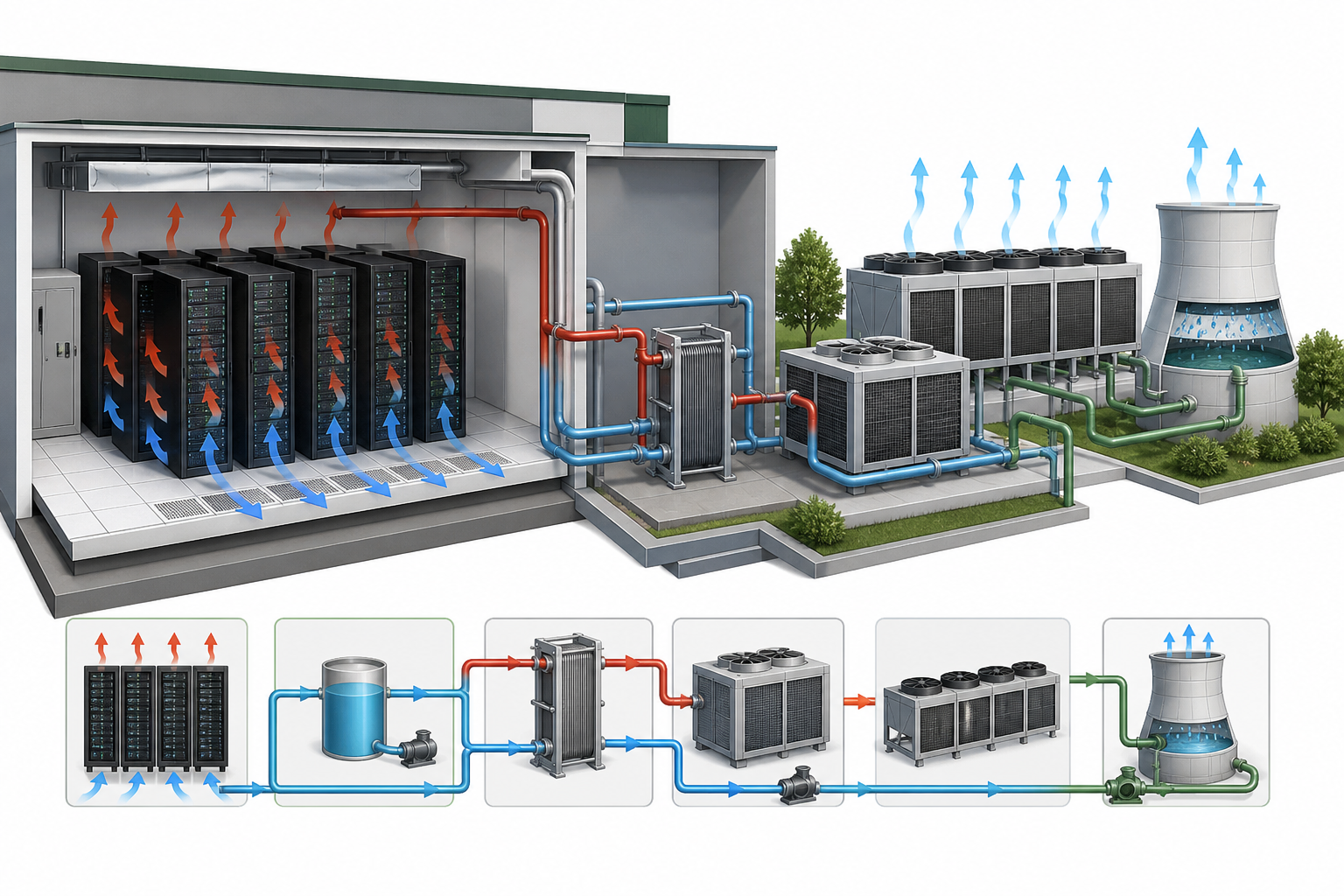
Educational illustration of evaporative data center cooling Higher Water Use Potential

Evaporative / open-loop cooling

Water helps carry heat away by evaporating. This can reduce cooling electricity in some climates, but it can increase water consumption and requires local water review.

Cooling systems, compared plainly

Cooling approach How it removes heat Typical water profile Water question to ask
Air-cooled / dry cooler Uses air and mechanical equipment to reject heat outside. Low ongoing water use, but may use more power in hot weather. What is the power efficiency tradeoff during hot weather?
Closed-loop chilled water Recirculates water or coolant through a sealed loop. Usually low consumption, with occasional makeup water or maintenance needs. How much makeup water is expected annually?
Evaporative cooling Uses evaporation to reject heat efficiently. Can consume more water, especially during warm, dry, or high-load periods. How much water is consumed and what source is used?
Liquid cooling Moves heat close to chips using liquid loops. Depends on how the outside heat rejection system is designed. Is the loop closed, and how is heat rejected outside?

Important water terms

Public discussions often mix these terms together. Separating them makes the project easier to evaluate.

Withdrawal Water taken from a source, such as a municipal system, well, reclaimed supply, or surface water.
Consumption Water that is not returned because it evaporates, is discharged elsewhere, or leaves the local system.
Makeup water Additional water added to replace losses in a cooling loop or cooling tower system.
Peak-day use The highest expected daily water demand, often during hot weather or high equipment load.
Annual use The total expected yearly water use, which is often more useful for comparing long-term community impact.

What a good water disclosure should include

System description

Name the cooling type, describe whether water is consumed or recirculated, and identify the outside heat rejection equipment.

Water source

Identify whether the project uses municipal water, reclaimed water, wells, surface water, industrial reuse, or a combination.

Expected quantities

Provide estimated annual consumption, peak-day demand, average-day demand, and any seasonal changes.

Operating limits

Explain drought response, water restriction procedures, reporting commitments, and whether reclaimed water can be used where available.

What communities should ask

What cooling type is being used?

Closed-loop, air-cooled, evaporative, hybrid, or liquid-cooled systems all behave differently.

What is the actual water source?

Municipal water, reclaimed water, wells, surface water, and industrial reuse all have different impacts.

What is the expected annual use?

Communities should ask for estimated annual consumption, not just peak-day numbers.

Key point: Data center water use is not one-size-fits-all. The cooling design matters more than the label "data center."